- Whitney Houston’s iconic Super Bowl XXV rendition remains the ‘holy grail’ of performances, with fans claiming no modern star can top her ‘soul-searing’ 1991 vocal.
- REVEALED: The secret behind the power was a daring shift from a traditional 3/4 waltz to a gospel-infused 4/4 meter that allowed Whitney to ‘nurture every note’ and reclaim the anthem for a generation.
- Recorded in a single, ‘miraculous’ take alongside The Florida Orchestra, the performance became a beacon of unity during the Gulf War and still triggers ‘instant tears’ for millions of viewers.
- As the dust settles on Super Bowl LX, social media is erupting with demands for the NFL to simply ‘play the tape’ of Whitney every year instead of risking ‘shameful’ live vocal meltdowns.
:max_bytes(150000):strip_icc():focal(999x0:1001x2)/whitney-houston-4-727de175c65c49a2b517216ddfa0936d.jpg)
It has been thirty-five years since Whitney Houston walked onto the turf at Tampa Stadium, dressed in a simple white tracksuit and headband, but the ‘shivers’ she sent down the spine of the world have never truly faded.
While modern divas often resort to ‘ear-splitting’ yodelling and frantic vocal runs, Whitney’s 1991 performance of The Star-Spangled Banner at Super Bowl XXV remains the undisputed ‘gold standard.’ It was a moment of pure magic that transformed a military waltz into a soul-searing anthem of hope and freedom.

Even as Super Bowl LX concluded yesterday in Santa Clara, the shadow of Houston’s greatness loomed large. Fans across the globe took to X (formerly Twitter) to declare that despite the glamorous efforts of today’s stars, Whitney is—and always will be—the ‘Voice’ of the game.
THE ‘RADICAL’ METER CHANGE
THE TRADITION: Most versions of the anthem are played in 3/4 time—a brisk, waltzy tempo that can feel rushed.
THE REVOLUTION: Whitney and music director Rickey Minor made the ‘scandalous’ decision to slow it down to a 4/4 soul meter.
THE RESULT: This gave Whitney 33% more time in every measure to ‘soar,’ allowing her to sing from the heart rather than the head.
The performance, backed by the Florida Orchestra, was famously recorded in just one take at a studio in California before the game. While the recording was played over the stadium speakers to ensure perfection amidst the furious roar of F-16 fighter jets overhead, the vocal was 100% Whitney—raw, powerful, and devoid of the ‘gimmicky’ screams that plague modern renditions.
“Every time I hear this… I get goosebumps,” one fan wrote in a viral post that has racked up millions of likes. “She SANG it. She didn’t scream or yodel. They should just show her singing on those big screens every year.”
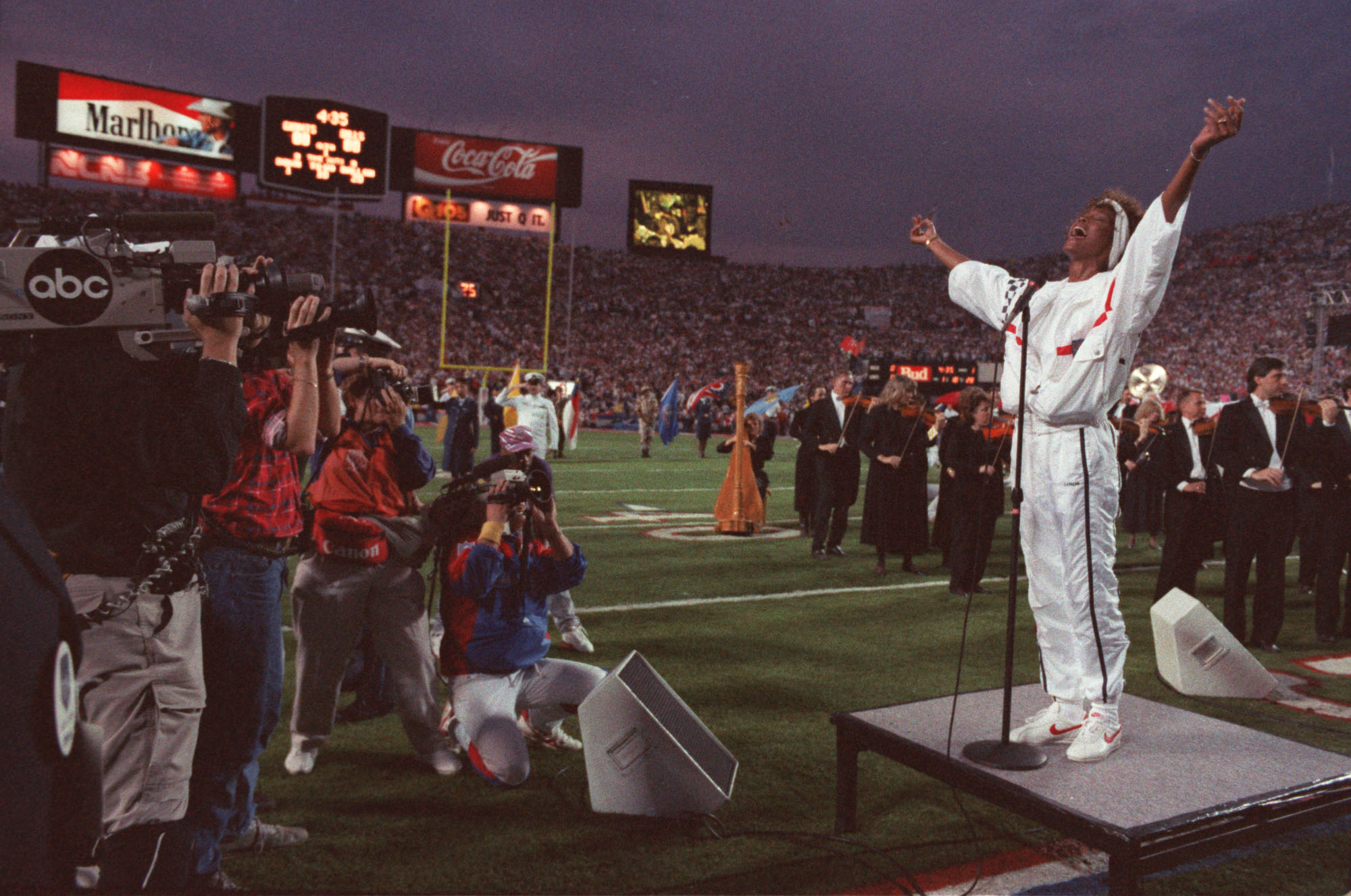
The historical weight of the moment was breathtaking. Set against the harrowing backdrop of the Persian Gulf War, Whitney’s rendition served as a ‘salve’ for a fractured nation. It was so successful that it was released as a single, reaching the Billboard Top 20—a feat nearly unheard of for a national anthem.
As we look back on three and a half decades of Super Bowl history, it is clear that Whitney Houston didn’t just sing a song; she created a legacy. Her ‘heavenly’ precision and ‘lavish’ tone remain the benchmark by which every other singer is measured—and usually found wanting.
In a world of ‘over-the-top’ theatrics, Whitney’s simple, tracksuit-clad brilliance reminds us that true talent doesn’t need a costume. It just needs a voice.
What do you think? Is Whitney’s version the greatest of all time, or is there a modern rendition that has finally topped her? Let us know in the comments below!